
How Aging Affects Thirst Sensation and Hydration
Last Updated: October 23, 2026
Quick Summary
Aging can blunt thirst sensation in many people, so the body's signal to drink may arrive later and softer, and some older adults become dehydrated without feeling very thirsty. Reduced urinary concentrating ability separately raises the risk of fluid loss, and total body water often decreases with age as body composition changes, which is why a scheduled fluid routine beats waiting for thirst alone.
- Total body water often decreases with age, partly because body composition changes, although the amount varies from person to person.
- Blunted thirst sensation and reduced urinary concentrating ability are two separate drivers of dehydration risk.
- Do not wait for thirst before offering fluids to an older adult.
- Drink fluids with meals and follow medication-specific instructions about timing and amounts to build a routine.
- Seek immediate medical help for sudden confusion or a sudden change from someone's usual alertness, since this needs urgent assessment and is not only caused by dehydration; also contact a doctor for dizziness on standing or other noticeable changes from usual health.
Table of Contents
- Why Aging Affects Thirst Sensation and Hydration
- How Aging Changes the Thirst Response and Fluid Balance
- Dehydration in Older Adults: Signs, Symptoms, and Risks
- Medications That Affect Hydration in Older Adults
- Daily Fluid Needs for Older Adults
- Hydration Tips for Seniors: Building a Routine That Works
- Monitoring Hydration Safely at Home and When to Talk to a Doctor
- Conclusion
- Frequently Asked Questions
Why Aging Affects Thirst Sensation and Hydration
Total body water often decreases with age, partly because body composition changes, although the amount varies from person to person, according to geriatric hydration guidance from ESPEN (the European Society for Clinical Nutrition and Metabolism). That shift matters because fluid balance gets harder to protect with age. At Autophagy Nutrition, we follow the research on healthy aging closely, and one finding stands out: thirst sensation can become less reliable over time, so it cannot be the only signal relied on. This guide explains how aging affects thirst sensation and hydration, what the risks look like, and how to build a routine that works.
Thirst sensation is the body's internal signal that prompts you to drink when fluid levels drop. It is a control system, not a preference.
How Aging Changes the Thirst Response and Fluid Balance
The thirst response weakens with age, and the science is clear on why. A study on aging and thirst in the journal Physiology & Behavior found that thirst triggered by low blood volume, high blood concentration, and dehydration all decline as people age. In plain terms, the alarm rings later and softer.
Several age-related changes drive this:
- Blunted thirst: The brain registers fluid loss less sharply.
- Weaker kidney function: The kidneys concentrate urine less well, so water leaves the body more readily.
- Lower total body water: Less reserve to draw on during illness or heat.
- Shifts in osmoregulation: The system that manages plasma osmolality and sodium balance becomes less precise.
Research from the National Institutes of Health review of hydration in older adults names blunted thirst sensation and reduced urinary concentrating ability as two key drivers of dehydration risk. The result: older adults can be dehydrated without feeling thirsty at all.
Learn how electrolyte hydration supports seniors as fluid levels shift with age.
Dehydration in Older Adults: Signs, Symptoms, and Risks
Dehydration in older adults often shows up quietly, and the stakes are real. A systematic review in Archives of Gerontology and Geriatrics linked dehydration in older people to higher mortality, a poorer course of illness, and greater healthcare costs.
Watch for these signs:
- Dry mouth and dark yellow urine
- Fatigue, dizziness, or weakness on standing
- Confusion or new cognitive changes
- Headaches and muscle cramps
- Fewer trips to the bathroom than usual
That last point trips people up. A common mistake is assuming a normal bathroom schedule means normal hydration. In practice, fewer trips to the bathroom may be worth noting, but on its own it cannot confirm or rule out dehydration, especially since thirst is not a dependable signal either.
Confusion deserves special attention, but not as a simple checklist item. A sudden change from someone's usual alertness or thinking is a medical emergency and needs prompt evaluation, since dehydration is only one of several possible causes. Do not try to resolve new confusion with fluids alone, and do not offer drinks to someone who is not fully alert or cannot swallow safely. Understanding how electrolytes support cognitive function can add useful context once a medical cause has been ruled out.
Medications That Affect Hydration in Older Adults
Medications are one of the most underrated causes of dehydration risk in this population. Diuretics increase urine output. Some laxatives can cause fluid loss through diarrhea. Some blood pressure drugs and antidepressants change thirst or sweating patterns.
Chronic conditions compound the problem. Kidney disease limits how well the body manages fluid and sodium. Diabetes raises urine output when blood sugar runs high. Heart failure often comes with fluid restrictions that make routine hydration planning more complex.
If you take several medications, ask your pharmacist one direct question: "Do any of these affect my fluid balance?" Anyone with a diagnosed condition that limits fluids should follow their care team's plan, not general hydration advice.
Daily Fluid Needs for Older Adults
There is no single correct number of ounces for every older adult, and any article that hands you one is oversimplifying.
What the general guidance says. The National Academies of Sciences, Engineering, and Medicine set an Adequate Intake for total water, meaning water from both beverages and food, of about 3.7 liters (roughly 125 ounces) per day for men and 2.7 liters (roughly 91 ounces) per day for women. Those figures are population reference values for healthy adults, not a prescription for any one person, and they include the water in soup, fruit, vegetables, yogurt, and other foods. Many older adults meet a meaningful share of their total water needs through food alone.
Why a fixed target misses the point. The Institute of Medicine's guidance assumes average conditions.
Lychee Premium Electrolyte Hydration Powder →
Adjusting by context. The table below shows how fluid needs shift across common situations. Treat it as a framework for conversation with a clinician, not a dosing chart.
| Situation | Adjustment to Daily Fluid Intake |
|---|---|
| Cool weather, low activity | Baseline intake, spread across the day |
| Hot weather or heating season | Add fluids; dry indoor air raises losses |
| Fever, vomiting, or diarrhea | Increase fluids and seek medical advice |
| Strenuous exercise or heavy sweating | Replace water and electrolytes |
| Fluid-restricted condition | Follow the care team's prescribed limit |
For vomiting or diarrhea, ask a pharmacist or clinician about a properly formulated oral rehydration solution. Ordinary electrolyte powders are not interchangeable with these solutions.
What counts as fluid. Plain water is the backbone for most people, but it is not the only source. Milk, tea, coffee, broth, and 100% juice all contribute.
When water alone is not enough. Most older adults do not need an electrolyte supplement simply because of their age. Ordinary drinks and meals cover everyday sodium, potassium, magnesium, and calcium needs for most people. After substantial sweating or other specific fluid losses, replacing electrolytes becomes more useful, and a flavored option can help because people tend to drink more when a drink tastes good.
Our Lemonade Premium Electrolyte Hydration Powder mixes one scoop into 14 to 20 ounces of water and provides sodium, potassium, magnesium, and calcium with no sugar and no caffeine. If you have kidney disease, heart failure, or a sodium or potassium restriction, check with your care team before using it.

Hydration Tips for Seniors: Building a Routine That Works
The most effective hydration routine for seniors does not depend on thirst. It depends on a schedule and easy access.
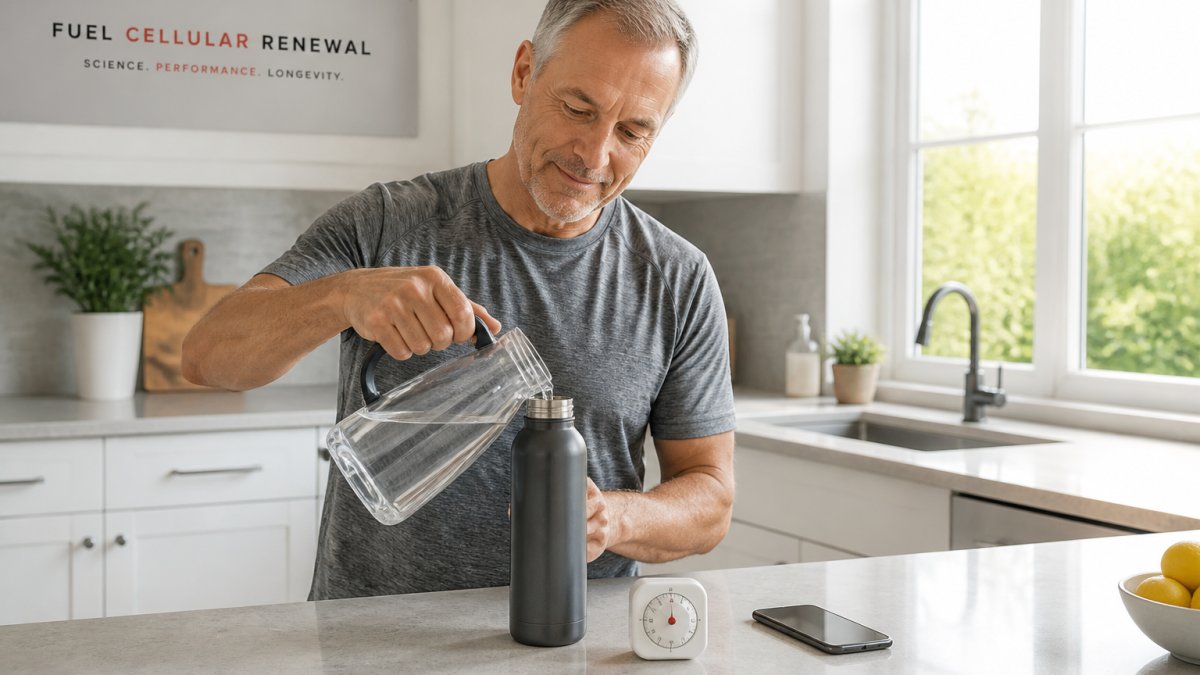
If there is a fluid restriction or a specific daily fluid goal from a doctor or dietitian, follow that plan instead of the general targets below. Otherwise, here is a routine we would build:
- Set anchor times. Drink a glass with each meal, and follow medication-specific instructions for fluid timing and amount.
- Use a visible bottle. Keep it in sight, not in a cupboard.
- Set a timer or phone reminder. Caregivers increasingly use scheduled prompts for exactly this reason.
- Pair fluids with habits. A glass after using the bathroom, after a walk, after waking.
- Add flavor when plain water gets boring. A little variety keeps intake steady.
- Eat water-rich foods. Soup, fruit, vegetables, and yogurt all count.
If the person you care for exercises, our guide on maintaining hydration during senior exercise programs covers timing around activity.
Monitoring Hydration Safely at Home and When to Talk to a Doctor
Home monitoring works best with simple, repeatable checks, and with a clear understanding of what each check can and cannot tell you. No single informal indicator is reliable on its own, especially in older adults, whose thirst signal often becomes less reliable with age.
A practical home checklist. Run through these at the same time each day so you are comparing like with like. None of these checks can confirm or rule out dehydration on their own; they may warrant attention when something changes from the person's usual pattern.
- Fluid intake. Track roughly how much the person actually drinks each day against their individual fluid goal. This is more informative than any single physical sign.
- Urine color. A change toward dark amber may warrant attention, but it cannot confirm or rule out dehydration on its own. Color is also affected by B vitamins (which can turn urine bright yellow), some medications, and foods like beets.
- Urine frequency and volume. Fewer trips to the bathroom than usual, or noticeably smaller amounts, may be worth noting, but on its own it cannot confirm or rule out dehydration.
- Morning body weight. If a clinician has set this up as part of a monitoring plan, weigh at the same time each morning, after using the bathroom and before eating, and report a sudden drop or rapid rise. Weight changes can reflect fluid shifts, but they have other causes too, so this is only useful within a plan a doctor has directed, not as a stand-alone check.
- Mental status. Sudden confusion, unusual drowsiness, or a sudden change from how the person usually thinks and communicates needs immediate medical assessment. Dehydration is only one of several possible causes, so this should never be treated with fluids alone, and you should not offer food or drink to someone who is not fully alert or cannot swallow safely.
- Physical signs. Dry mouth, dizziness on standing, weakness, headaches, and muscle cramps can occur with dehydration, but each also has other common causes, so none of them confirms it on its own.
What informal checks cannot do. Thirst, urine color, urine output, dry mouth, and body weight are useful signals, but none of them can confirm or rule out low-intake dehydration in an older adult on its own. Each has confounders, and clinical assessment, sometimes including blood tests, is what actually confirms or excludes dehydration when it is suspected.
Swallowing, mobility, and access barriers. Hydration often fails for mechanical reasons, not motivational ones. Dysphagia (difficulty swallowing) can make drinking unsafe or unpleasant; a speech-language pathologist can assess and recommend texture modifications.
When to call a doctor. Seek medical advice promptly if you see:
Seek immediate medical help for sudden confusion, unusual drowsiness, or a sudden change from the person's usual alertness. Do not try to treat this with fluids alone or offer drinks to someone who is not fully alert or cannot swallow safely.
- Very dark urine or no urination for many hours
- Dizziness on standing or a fall
- Persistent vomiting or diarrhea
- Rapid weight loss over a day or two
Conclusion
Thirst often becomes a less reliable signal with age, which is part of what makes hydration harder to manage. Building a routine around scheduled fluids, visible bottles, and electrolyte options closes that gap. Autophagy Nutrition makes clean hydration powders with sodium, potassium, magnesium, and calcium, no sugar, and no caffeine, in flavors like Lemonade and Peach Mango. Anyone with kidney disease, heart failure, or a sodium or potassium restriction should check with their care team before using an electrolyte supplement. Shop All and give your daily routine a reliable foundation.
Frequently Asked Questions
Does the sensation of thirst decrease with age?
Yes. Research shows the thirst response to fluid loss weakens with age. A 2001 NIH review found that aging alters physiological control systems, leaving older men and women with a diminished thirst response. A 2017 study in Physiology & Behavior reported that thirst triggered by hypovolemia, hypertonicity, and dehydration all decline with aging. In practice, this means an older adult can be low on fluid without feeling the urge to drink, so scheduled fluid intake matters more than waiting for thirst.
Why can thirst be a less reliable signal for older adults?
Two separate age-related changes can increase dehydration risk. First, the thirst sensation can become blunted, so the brain signals for water less strongly after fluid loss. Second, kidney function can change: reduced urinary concentrating ability means the body holds onto water less efficiently, which affects fluid balance independently of thirst. A 2023 PMC review lists both blunted thirst sensation and reduced urinary concentrating ability as factors in older adult dehydration risk. Because the warning signal can fade, caregivers often rely on timers and hydration schedules instead.
How much water should a 70-year-old drink per day?
There is no single number that fits every 70-year-old. Daily fluid needs for older adults depend on body size, activity, climate, medications, and medical conditions such as heart or kidney disease that may require fluid restriction. A practical approach is to spread fluids across the day, include water-rich foods, and watch for signs like dark urine or fatigue. Anyone with a diagnosed condition or a prescribed fluid limit should follow their doctor's target rather than a general guideline.
Can an 80-year-old drink too much water?
Yes. Drinking more water than the kidneys can excrete can dilute blood sodium, a condition called hyponatremia. Risk increases with impaired water excretion, certain medications, and heart, kidney, or liver conditions. This does not mean restricting fluids without medical advice. Drinking steadily rather than in large bursts can help, but it does not eliminate the risk, so anyone with a fluid restriction a doctor has set for heart, kidney, or liver conditions should follow it closely.
