
What Foods Support Cellular Repair and Maintenance?
Table of Contents
- What "Cellular Repair" Actually Means in Nutrition Science
- The Role of Autophagy in Human Health
- Key Nutrients and Foods That Support Cellular Maintenance
- Dietary Polyphenols and Cellular Function: What We Know
- The Importance of Protein for Aging Adults
- How to Support Mitochondrial Health Through Diet
- Fasting, Exercise, and Sleep: Lifestyle Factors Studied Alongside Nutrition
- What to Ignore: Bad Advice About "Cell Repair" Foods
- Frequently Asked Questions
Last Updated: September 17, 2026
What "Cellular Repair" Actually Means in Nutrition Science
The phrase "cellular repair" is shorthand, not a single measurable biological event. It describes a group of ongoing processes: DNA repair, protein quality control, antioxidant defenses, mitochondrial maintenance, membrane repair, tissue remodeling, and cellular recycling such as autophagy. No food turns these processes on or off like a switch.
The Role of Autophagy in Human Health
Autophagy is a normal cellular recycling and quality-control process in which cells break down and reuse their own components. It operates continuously at a baseline level and responds to conditions like nutrient availability and energy status.
What the Evidence Does and Does Not Show
Most of what we know about autophagy and specific foods comes from cell-culture and animal research. Those studies map molecular pathways; they do not prove that eating a particular food produces the same effect in people. Human autophagy is difficult to measure directly, varies by tissue, and cannot be reduced to a simple fasting timer.
- Fasting, exercise, and energy availability are studied as factors related to autophagy in mechanistic and animal models.
- More autophagy is not automatically better; it is a dynamic system, not a dial to maximize.
- No single food "activates" autophagy in humans, and no specific fasting-hour threshold reliably marks its onset.
Key Nutrients and Foods That Support Cellular Maintenance
The most useful frame is dietary patterns, not superfoods. A varied diet supplying protein, micronutrients, fiber, and omega-3s gives the body what it needs for routine maintenance. Below is how the major categories fit, and which specific nutrients within them have well-described roles in normal physiology.
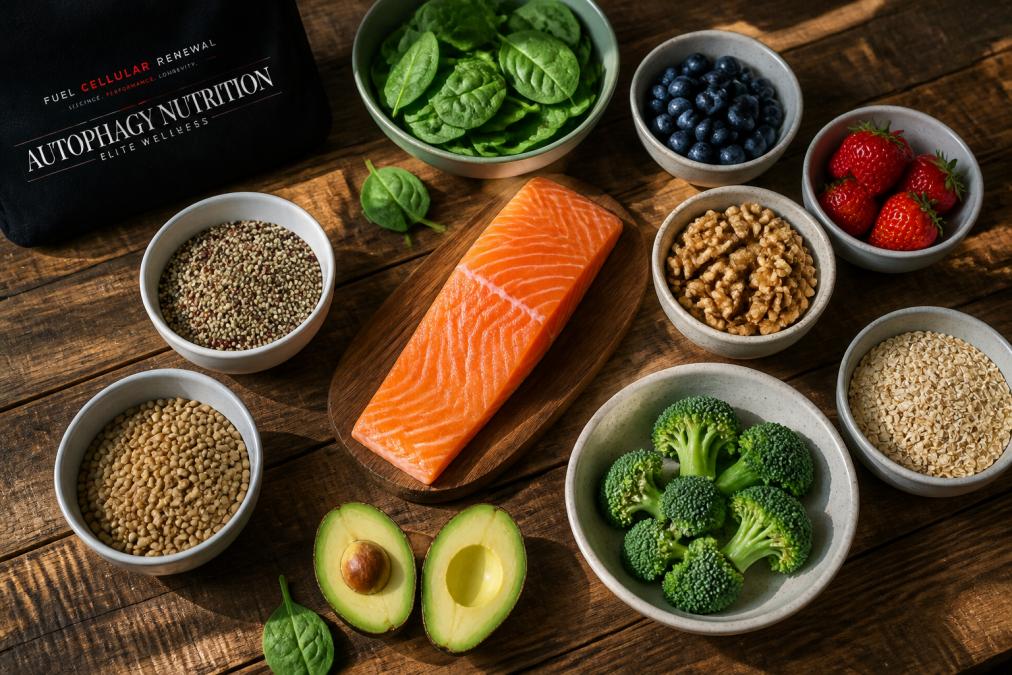
Protein and Essential Amino Acids
Protein supplies the amino acids used for tissue protein synthesis and repair. Adequate intake matters most for active adults and older adults, whose maintenance needs stay high even as muscle mass tends to decline. Protein is not the enemy of cellular health because amino acids interact with mTOR signaling; autophagy and mTOR are both normal, dynamic systems, not opposing good-and-bad switches.
- Leucine, found in eggs, dairy, poultry, and soy, is one of the amino acids studied for its role in triggering muscle protein synthesis.
- Lysine and methionine are essential amino acids the body cannot make and must obtain from food.
- A common practical pattern is to spread protein across meals rather than loading it all at dinner, since muscle protein synthesis responds to repeated stimulation.
Micronutrients With Named Roles in Normal Cellular Processes
This is where most food lists get vague. Here are specific nutrients, common food sources, and what they actually do in ordinary physiology:
| Nutrient | Example Foods | Normal Physiological Role |
|---|---|---|
| Vitamin C | Citrus, bell peppers, strawberries | Cofactor for collagen synthesis; supports normal antioxidant recycling |
| Vitamin E | Almonds, sunflower seeds, spinach | Fat-soluble antioxidant that contributes to normal antioxidant defense and protection of cell membranes from oxidative damage |
| Zinc | Oysters, beef, pumpkin seeds | Cofactor for many enzymes involved in normal cellular processes, including protein synthesis |
| Selenium | Brazil nuts, tuna, eggs | Component of antioxidant enzymes like glutathione peroxidase |
| Magnesium | Leafy greens, nuts, beans | Cofactor in ATP metabolism and hundreds of enzymatic reactions |
| B vitamins (folate, B12) | Leafy greens, eggs, fortified grains | Involved in DNA synthesis and methylation reactions |
| Omega-3 fatty acids | Salmon, sardines, walnuts, flax | Support membrane fluidity and normal inflammatory-response physiology |
| Fiber | Beans, oats, whole grains | Feeds gut bacteria that produce short-chain fatty acids |
The Absorption Angle Most Articles Skip
Getting a nutrient into your mouth is not the same as getting it into your cells. A few practical pairings improve absorption:
- Fat-soluble vitamins (A, D, E, K) and carotenoids absorb better when eaten with a source of fat. Pairing these foods with a source of dietary fat, such as olive oil, can improve absorption of the fat-soluble vitamins and carotenoids they contain.
- Plant iron (non-heme) absorbs better alongside vitamin C. Pair lentils with bell peppers or citrus.
- Calcium and iron can compete for absorption when consumed in the same meal, though this interaction is generally minor within a normal, varied diet.
- Cooking method matters. Lycopene in tomatoes becomes more bioavailable when cooked; water-soluble vitamins like C can degrade with prolonged heat.
Dietary Polyphenols and Cellular Function: What We Know
Polyphenols are plant compounds studied for their antioxidant and cell-signaling roles. Common examples include quercetin, resveratrol, curcumin, and sulforaphane, found in foods like onions, grapes, turmeric, and cruciferous vegetables.
Why Bioavailability Changes Everything
This is the part most "superfood" articles leave out. Even when a polyphenol shows activity in a laboratory, the amount that reaches your bloodstream and target tissues after eating is often a small fraction of what was in the food. Several factors limit this:
- Low absorption. Many polyphenols are poorly absorbed in the small intestine.
- Rapid metabolism. The body often converts them into different compounds (metabolites) that may or may not retain the original activity.
- Gut bacteria matter. Some polyphenols are broken down by gut microbes into smaller metabolites that are what actually circulate.
- Food matrix effects. The same compound may behave differently depending on whether it comes from a whole food, a juice, or a supplement.
What the Evidence Actually Supports
- Quercetin (onions, apples, tea) is studied for antioxidant and signaling roles, but human outcome data is limited.
- Resveratrol (grapes, red wine) has generated interest from animal research, but human trials have not shown consistent, meaningful effects at typical dietary intakes.
- Curcumin (turmeric) is notoriously poorly absorbed on its own; research often uses formulations designed to enhance bioavailability.
- Sulforaphane (broccoli, Brussels sprouts) is studied for its role in activating certain cellular defense pathways, but again, most evidence is mechanistic or animal-based.
Antioxidants Are Not a Simple Cleanup Crew
Antioxidants also do not simply "neutralize all free radicals." Reactive oxygen species play normal signaling roles in the body, so the biology is more nuanced than wiping out oxidation. The goal is balance, not elimination.
A Practical Takeaway
Eat a variety of colorful plant foods. The combination of polyphenols, fiber, vitamins, and minerals in whole foods is more likely to support normal physiology than isolating any single compound, and the gut bacteria that help metabolize polyphenols are themselves fed by the fiber in those same foods.
The Importance of Protein for Aging Adults
Adequate protein is one of the few nutrition points where the case is strong and practical. Older adults and active adults need enough high-quality protein to maintain muscle, support recovery, and preserve function. The goal is sufficiency, not restriction.
- Aim to spread protein across meals rather than loading it at dinner.
- Pair protein with resistance training for the best maintenance of strength.
- Do not cut protein to chase longevity claims; chronic restriction is not a supported strategy.
How to Support Mitochondrial Health Through Diet
Mitochondria produce ATP, the energy currency cells run on, so mitochondrial function sits close to any conversation about cellular energy. Diet supports this system indirectly: micronutrients act as cofactors in energy metabolism, and overall nutrient density keeps the machinery supplied.
Fasting, Exercise, and Sleep: Lifestyle Factors Studied Alongside Nutrition
Fasting, exercise, and sleep are studied alongside nutrition because they interact with energy status and recovery. Exercise is a physiological stimulus associated with cellular adaptation and remodeling. Sleep supports normal recovery processes. Fasting affects nutrient availability and metabolic signaling.
What to Ignore: Bad Advice About "Cell Repair" Foods
Most "cell repair" content fails for the same reason: it converts laboratory mechanisms into promises. Watch for these patterns.
- "This food repairs DNA." No single food does this; DNA repair is an internal process supported by nutrients, not performed by a berry.
- "This activates autophagy in humans." Cell and animal findings are not human proof.
- "Antioxidants wipe out all free radicals." Reactive oxygen species have normal signaling roles.
- "Detoxes your cells." Cells manage their own waste through processes like autophagy; food does not "detox" them.
- "Turns on longevity genes." This language overstates the evidence and skips the human-outcome gap.
Frequently Asked Questions
What foods can help repair cellular damage?
No single food repairs cells on its own. Cellular repair is an umbrella term covering DNA repair, protein quality control, antioxidant defenses, and autophagy, and these processes depend on overall diet quality. Foods that supply the raw materials for normal maintenance include protein sources for tissue synthesis, omega-3-rich fish, fruits and vegetables for vitamins and polyphenols, and fiber-rich foods that support gut health. The pattern matters more than any one item: a varied, nutrient-dense diet supports the physiology that keeps cells functioning normally.
Is there a specific diet that guarantees cellular repair?
No diet guarantees cellular repair, because there is no single measurable state to increase. What research supports is that nutrient-dense dietary patterns rich in protein, omega-3 fatty acids, micronutrients, fiber, and polyphenols, including Mediterranean-style and plant-forward patterns, have been studied in relation to healthy aging, cardiometabolic health, and other outcomes. These are largely observational associations, not proof of cause and effect. Treat any eating plan promising guaranteed cell repair with skepticism, and focus on consistency, nutrient density, and adequate protein across the day.
How does protein intake support tissue and cellular health?
Protein supplies essential amino acids that the body uses for tissue protein synthesis, including the ongoing turnover of muscle and other tissues. For active adults and those over 40, adequate protein becomes more important because muscle maintenance grows harder with age. Protein also interacts with mTOR signaling, a normal growth and repair pathway, but that does not make protein bad for longevity. Autophagy and mTOR are dynamic systems, not opposing switches, and chronic protein restriction is not a proven longevity strategy.
How do lifestyle factors like sleep and exercise relate to cellular recovery?
Exercise is a physiological stimulus associated with cellular adaptation and remodeling, and sleep supports normal recovery and metabolic function. Neither should be framed as a protocol for triggering autophagy in humans: much of that evidence comes from mechanistic and animal studies, and human measurement is difficult. Think of sleep, training, and nutrition as complementary inputs. A diet built around protein, micronutrients, and polyphenols works best alongside consistent sleep and regular activity, not as a replacement for them.