
NAD+ Dosage for Beginners: What Research Shows
Table of Contents
- NAD+ Dosage for Beginners: What the Science Actually Says
- Why There Is No Official Beginner Dose
- What You'll Need Before You Start
- NMN vs NR for NAD+ Levels: Which Precursor Has Better Evidence?
- Human Clinical Trials on NAD+ Precursors: What They Measured
- How Long NAD+ Supplements Take to Work: Biomarkers vs. How You Feel
- How to Choose a High-Quality NAD+ Supplement
- Timing, Absorption, and What Not to Mix With NAD+ Precursors
- Individual Variability and the Placebo Factor in NAD+ Supplementation
- Common Mistakes Beginners Make With NAD+ Dosage
- Frequently Asked Questions
Last Updated: October 2, 2026
NAD+ Dosage for Beginners: What the Science Actually Says
There is no official NAD+ dosage for beginners. NAD+ is a coenzyme your cells already make and use in energy metabolism, and no health agency has set a recommended daily intake for it as a supplement. This guide from Autophagy Nutrition covers what human trials have measured, what those measurements do and do not prove, and how to think about a starting point without inventing one.
Most beginner guides skip that nuance and hand you a number. Below: the research, the open questions, and a practical way to track your own response.
Why There Is No Official Beginner Dose
No regulator has established a daily value for NAD+ or its precursors because the evidence base is still young. Researchers are still working out how much of an oral dose reaches systemic circulation, how long it stays there, and what a change in a blood marker means for health.
NAD+ levels tend to decline with age, studied as part of normal cellular aging. What is not known is whether raising a blood marker back toward a younger level produces a meaningful change in how someone feels or functions. Those are two different claims, and the second is not settled.
What You'll Need Before You Start
Before you buy anything, get three things in order. First, a baseline: ask your doctor whether a blood panel makes sense, and record how you sleep, train, and feel for two weeks before you start. Second, a clear goal in plain terms like "steadier afternoon energy" rather than "anti-aging." Third, a way to log what you take and when.
- A two-week pre-supplement log of sleep, energy, and training
- A doctor conversation about interactions with anything you already take
- One product at a time, so you can attribute any change
- A consistent time of day for taking it
NMN vs NR for NAD+ Levels: Which Precursor Has Better Evidence?
Both NMN and NR are NAD+ precursors, meaning the body can use them in the pathways that build NAD+. They are not the same compound, and evidence for one does not transfer to the other.
Nicotinamide riboside (NR) has the longer human research history, with trials measuring how oral NR changes NAD+ levels in blood and some tissues.
| Precursor | Human Evidence Base | What Trials Measured | Key Limitation |
|---|---|---|---|
| NR (nicotinamide riboside) | Larger, longer-running | NAD+ levels in blood and tissue | Few clinical outcome endpoints |
| NMN (nicotinamide mononucleotide) | Smaller, newer | Safety, tolerability, NAD+ markers | Short durations, small samples |
| Niacin (nicotinic acid) | Long-established for other uses | Lipids, not NAD+ status | Different compound, different effects |
Human Clinical Trials on NAD+ Precursors: What They Measured
Human trials in this field have mostly measured biomarkers, not how people feel. The useful question is not "did a trial happen" but "which compound, at what dose, for how long, in whom, and what did it measure." Here is the published human literature laid out that way.
NR (Nicotinamide Riboside): The Longer Human Record
NR has the deepest human dataset of any NAD+ precursor sold today.
A separate 2018 Nature Communications trial (Martens et al.) gave 500 mg of NR twice daily (1,000 mg total) to healthy middle-aged and older adults for six weeks and reported increases in NAD+ levels in blood.
NMN (Nicotinamide Mononucleotide): Smaller, Newer, Mostly Safety-Focused
The NMN human literature is younger and thinner. A 2020 Endocrine Journal trial (Irie et al.) gave healthy Japanese men a single oral dose of NMN at 100 mg, 250 mg, or 500 mg and tracked safety and pharmacokinetics over several hours; it reported the compound was well tolerated and NAD-related metabolites rose, but the study was single-dose and short.
What the Trial Record Actually Supports
Three things stand out:
- Oral NR and oral NMN can raise NAD-related markers in humans. This is the most consistently replicated finding.
- Doses studied in humans range widely, roughly 100 mg to 1,000 mg per day for NR, and roughly 100 mg to 500 mg per day for NMN, with no established dose-response curve for clinical outcomes.
- Functional and clinical endpoints are inconsistent. Some trials show small signals; others show nothing. None has been powered or run long enough to support claims about aging, disease risk, or lifespan.
Why the Trials Are Hard to Compare
You cannot line these studies up and read off a "best" number, because they differ on nearly every axis:
| Variable | What Varies Across Trials |
|---|---|
| Compound | NR vs. NMN vs. niacin, different molecules, different evidence |
| Dose | 100 mg to 1,000 mg per day depending on the study |
| Duration | Single dose up to 12 weeks; almost nothing longer |
| Population | Healthy younger adults, healthy older adults, specific clinical groups |
| Endpoint | Blood NAD+ markers, muscle NAD+, safety labs, or functional tests |
| Sample size | Often small, many trials enroll fewer than 100 participants |
That heterogeneity is what an early-stage field looks like, but it means any article handing you a single "proven" dose is skipping the part where the evidence is thin.
What the Trials Do Not Show
No published human trial of NR or NMN has demonstrated that raising NAD+ markers reverses aging, extends lifespan, prevents disease, or produces a clinically meaningful anti-aging effect. Some trials showed small improvements in specific measured endpoints; others showed none. The biomarker signal is real; the clinical signal is not yet established.
How Long NAD+ Supplements Take to Work: Biomarkers vs. How You Feel
There are three separate clocks here, and beginners usually collapse them into one. The first is absorption: how quickly a dose appears in your bloodstream.
Only the first two have been measured with any consistency. The third is where most marketing claims live, and where the evidence is thinnest.
Subjective vs. Objective Metrics: What to Track
Track both, but keep them in separate columns. Objective metrics include any bloodwork your doctor orders and hard numbers like sleep duration from a wearable or training output from a logged workout. Subjective metrics include your own 1-to-5 ratings for energy, focus, and recovery, recorded at the same time each day.
Nicotinamide Adenine Dinucleotide (NAD+) Dietary Supplement →
How to Choose a High-Quality NAD+ Supplement
Label transparency beats marketing copy every time. A high-quality NAD+ supplement tells you exactly which compound is in the bottle, how much per serving, and what else is in the capsule.
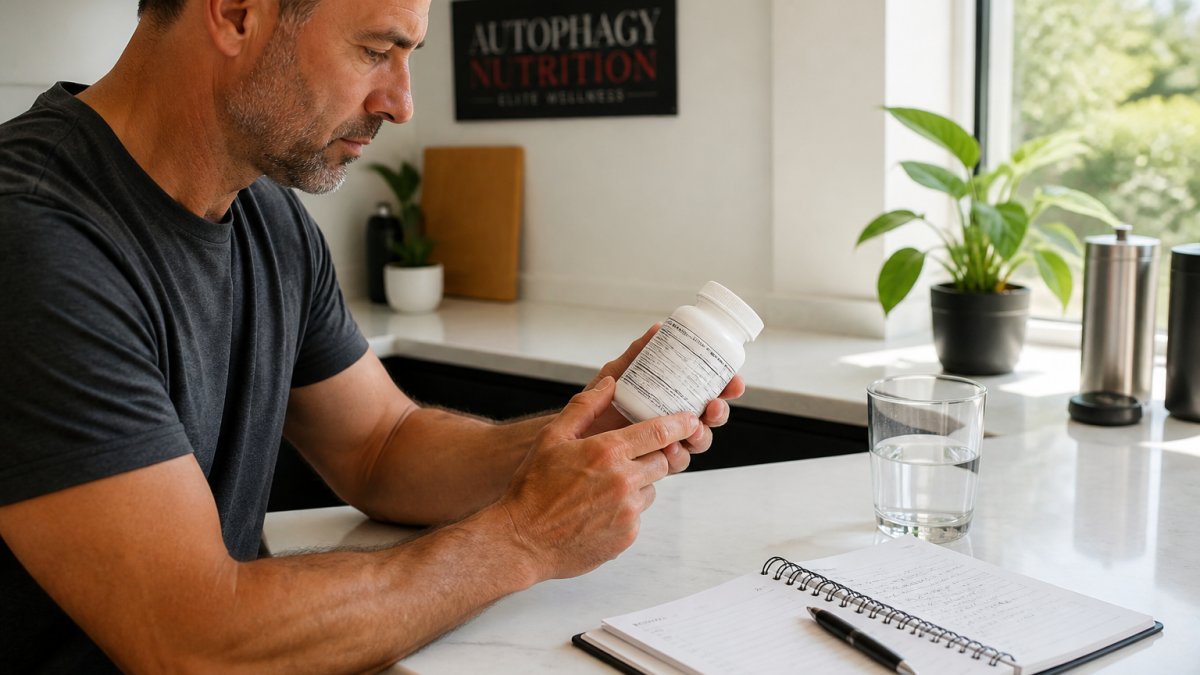
Look for a clear serving size. Autophagy Nutrition's NAD+ capsules list Nicotinamide Adenine Dinucleotide along with quercetin dihydrate extract, Japanese knotweed extract standardized to 98% resveratrol, and standard capsule ingredients, with a suggested adult serving of two capsules daily. The NMN option is a single-ingredient formula providing 500 mg of beta-Nicotinamide Mononucleotide per serving, with a suggested adult serving of one capsule daily. Both use vegetable capsules.

Read those serving lines as label directions, not as clinically proven optimal doses. No trial has established that the label amount is the "right" amount for you.
- Check the exact compound name, not just the category
- Confirm the amount per serving, not per container
- Look for third-party testing or a certificate of analysis
- Prefer formulas you can take one at a time
Timing, Absorption, and What Not to Mix With NAD+ Precursors
Human trials have not established an optimal time of day for taking NAD+ precursors. Some people choose to take them in the morning simply because that is when they already take other supplements, a routine preference, not an evidence-based efficacy strategy.
What is worth understanding is what happens to an oral dose after you swallow it, because that is where most of the variability lives.
The Absorption Path: Why Oral Precursors Are Not Straightforward
NAD+ itself is a large, charged molecule. Direct human pharmacokinetic evidence for orally administered NAD+ itself is limited, and it is uncertain how much intact NAD+ reaches systemic circulation versus being metabolized into related compounds that may then participate in NAD+ metabolism. NR and NMN are separate NAD+ precursors with their own body of human research; that research does not establish how well, or whether, oral NAD+ itself is absorbed or effective.
Food Timing and the Trade-Off Nobody Explains
Human research has not established whether taking NMN, NR, or oral NAD+ with versus without food meaningfully changes absorption or outcomes. Follow the product label and use a routine you tolerate consistently.
Morning vs. Evening: What the Evidence Actually Says
The morning-dosing convention comes from convenience (people already take supplements then) and anecdote (some users report later dosing interferes with sleep). Neither is a trial finding. What is reasonable: if taking a precursor later in the day affects your sleep, take it earlier; if you notice nothing either way, pick the time you will actually remember; and do not switch times mid-trial, if you are tracking, consistency matters more than the clock.
What Not to Stack
The cautious answer is the correct one. If you take prescription medication, have a liver or kidney condition, are pregnant or nursing, or take other supplements, talk to your doctor or pharmacist before adding a precursor. On stacking: do not combine multiple NAD-related compounds at once when starting out, since NR, NMN, and niacin all feed into overlapping pathways and you will not know which one caused any problem; be cautious with high-dose niacin, a different compound with a different evidence base, used clinically for lipid management, not for NAD+ status, that can cause flushing and, in some people, liver effects; and check interactions with anything that affects how you metabolize other drugs, a conversation for your pharmacist, not a blog.
The Co-Factor Question: TMG, Resveratrol, and Why Beginners Ask
A common question is whether to add co-factors like TMG (trimethylglycine) or resveratrol alongside a precursor. Human evidence for these combinations is limited and mixed. TMG is sometimes discussed because methylation is involved in NAD+ metabolism, and some users anecdotally report pairing it with NR or NMN, but no high-quality human trial establishes that this combination improves outcomes.
A Note on Product Formulation
Ingredient-level research does not automatically establish the effects of a finished supplement product. A study using a particular NMN or NR preparation is not a clinical study of every commercial product containing that ingredient.
Individual Variability and the Placebo Factor in NAD+ Supplementation
People can report different experiences while taking the same supplement. Subjective outcomes such as energy, focus, sleep, and recovery are influenced by many factors, including expectation and unrelated changes in sleep, diet, activity, stress, and health. Those experiences should not be treated as direct evidence of a change in NAD+.
Common Mistakes Beginners Make With NAD+ Dosage
The first mistake is starting high because a headline said more is better. Dose-response has not been established for human outcomes, so a bigger number is not a better plan. The second is stacking three NAD-related products at once, you learn nothing and risk stomach upset you cannot trace.
- Starting at a high dose with no baseline
- Combining multiple precursors from day one
- Relying only on how you feel
- Changing dose, timing, or multiple supplements so frequently that it becomes difficult to evaluate tolerability or subjective changes
- Ignoring interactions with existing medication
Sorting real evidence from confident marketing is the hard part of this category. Autophagy Nutrition builds clean, science-forward formulas for people who want to know exactly what is in the bottle: NAD+ capsules with a fully listed ingredient panel, a single-ingredient NMN option at 500 mg per serving, and label directions that state a serving size rather than a promise. Start with a baseline, change one thing at a time, and track what actually moves. Shop All at Autophagy Nutrition.

Frequently Asked Questions
What is the difference between NAD+, NMN, and NR?
NAD+ is the coenzyme itself, while NMN (nicotinamide mononucleotide) and NR (nicotinamide riboside) are precursors the body converts through different steps to support NAD+ biosynthesis. Human trials have studied NMN and NR separately, so evidence for one compound does not automatically apply to another. NAD+ capsules, such as those from Autophagy Nutrition, supply the coenzyme directly, but researchers are still working out how much oral NAD+ reaches systemic circulation intact versus being broken down and recycled.
How can I tell if an NAD+ precursor supplement is working?
Blood NAD+ or related biomarker testing may provide information about circulating markers, but it does not establish whole-body or tissue-specific NAD+ status and does not prove that a supplement produced a meaningful health benefit. Subjective feelings like better energy or focus are not proof that NAD+ increased, since sleep, diet, training, and expectation can all shift how you feel. If you want objective data, ask a healthcare professional about baseline and follow-up testing, and track simple markers like sleep quality and workout recovery in a log alongside any lab results.
Are there known side effects of taking NAD+ precursors?
Published human trials on NMN and NR have generally reported good tolerability at the doses studied, with some participants noting mild digestive discomfort or headaches. Those trials used specific compounds, doses, and durations, so they do not guarantee the same experience with every product. If you take other supplements or medications, have a chronic condition, or are pregnant or nursing, talk to a healthcare professional before starting, and follow the label directions rather than improvising a higher dose.
Should I consult a doctor before starting NAD+ support?
Yes, particularly for people who take prescription medications, have diagnosed medical conditions, are pregnant or nursing, are preparing for a medical procedure, have concerns about drug or supplement interactions, or are unsure whether the supplement is appropriate for them. A clinician can review interactions, order baseline bloodwork, and help you interpret any changes objectively. Bring the actual product label so they can see the ingredients and serving size. Autophagy Nutrition's NAD+ capsules list NAD+, quercetin dihydrate, and Japanese knotweed extract (98% resveratrol), and the suggested use is two capsules daily with water or as directed by a healthcare professional.