
How to Activate Longevity Pathways Naturally in 2026
Table of Contents
- What Are Longevity Pathways and How Do They Work?
- AMPK Activation Strategies for Metabolic Health
- The Role of Autophagy in Cellular Recycling
- Hormetic Stress and Adaptive Responses
- Impact of Resistance Training on Longevity
- Nutrition Strategies to Support Longevity Pathways
- Tracking Progress and Safety Considerations
- Conclusion: Building Your Longevity Routine
- Frequently Asked Questions
Last Updated: September 13, 2026
What Are Longevity Pathways and How Do They Work?
Longevity pathways are cellular signaling networks studied in aging biology, involved in energy management, cellular maintenance, and stress response. Diet, exercise, fasting, temperature exposure, and sleep can influence these systems, but influencing a pathway is not the same as switching it on or producing a longer life.
Most research is mechanistic, often from animal and cell models: the systems respond to lifestyle inputs, but human outcome data is still developing. What follows covers the most consistently studied levers, noting where evidence is strong and where it is preliminary.
Key Molecular Pathways Involved in Healthy Aging
The five pathways studied most often in aging research are AMPK, sirtuins, mTOR, autophagy, and insulin signaling — cellular processes examined in that research, not proven human "longevity switches." Each responds to different inputs:
- AMPK senses low cellular energy and shifts metabolism toward breakdown and cellular maintenance
- Sirtuins are proteins linked to stress response and DNA maintenance in preclinical work
- mTOR drives growth and protein synthesis when nutrients are abundant
- Autophagy is the cell's recycling process for damaged components
- Insulin sensitivity determines how efficiently cells take up glucose
These systems interact. Fasting, for example, can influence AMPK and autophagy at once, which is why lifestyle changes tend to have broader effects than any single intervention.
AMPK Activation Strategies for Metabolic Health
AMPK is an energy-sensing pathway: it responds to a rising AMP-to-ATP ratio, becoming more active as cells sense energy is scarce. That mechanism is established cell physiology; how reliably specific routines influence it in ways that affect human longevity is far less settled.
Exercise and calorie restriction are the most studied inputs: brisk walking, fasting, and hard training sessions are all associated with the energy-deficit signals AMPK responds to in research settings. Cold exposure is also studied, though human data is thinner. Most of this evidence describes acute biological responses; whether it translates into long-term human health or longevity outcomes is still limited.
AMPK activity is transient, it rises and falls with daily behavior, so consistency matters more than any single heroic effort.
Exercise and Calorie Restriction as AMPK Triggers
Exercise is the most studied way to influence AMPK: endurance work and resistance training both create the energy demand associated with AMPK activity, scaling with intensity and duration. This reflects an acute physiological response; how it translates into long-term outcomes in humans is less established.
Calorie restriction is the other classic input. Reducing total intake, or compressing eating into a shorter window, creates the low-energy signal AMPK responds to. The NIH National Institute on Aging research on calorie restriction and aging has examined this relationship in both animal and human studies, with results that are promising but not yet definitive for long-term human outcomes.
Moderate restriction is the realistic target. Aggressive, prolonged restriction carries risks that outweigh the theoretical benefit for most people.
The Role of Autophagy in Cellular Recycling
Autophagy breaks down damaged proteins and organelles and reuses their components. It operates at a low level constantly and ramps up under stress.
Fasting is the most discussed trigger: in cell and animal studies, reduced nutrient and insulin signaling shifts cells toward more autophagic activity relative to a fed state, and autophagy increases in these preclinical models under fasting conditions. Evidence in humans is far more limited and indirect, and it does not establish that fasting reliably raises systemic autophagy the way animal studies suggest. How much this translates to human health outcomes is still an open question, and no one can honestly tell you autophagy "starts" at a specific hour.
Intermittent Fasting and Fasting Windows
Intermittent fasting extends the period your body spends in a low-insulin, low-nutrient state. Common approaches include a 16:8 daily window, a 5:2 weekly pattern, and longer occasional fasts.
A strict fast means zero caloric intake. Anything with calories, including most supplements and even small amounts of creamer, interrupts the fasted state. Noncaloric beverages such as water, plain black coffee, and unsweetened tea are commonly used during fasting practices.
Approach |
Typical Window |
Difficulty |
|---|---|---|
16:8 daily |
16 hours fasted |
Moderate |
14:10 daily |
14 hours fasted |
Low |
5:2 weekly |
2 low-calorie days |
High |
24-hour fast |
Once weekly or monthly |
Very high |
Start with the easiest option that fits your schedule. Adherence beats intensity.
Hormetic Stress and Adaptive Responses
Hormesis is the principle that a mild, short-lived stressor can prompt an adaptive response that leaves a system more resilient. In aging research, three stressors get the most attention: heat, cold, and reactive oxygen species generated by exercise. The immediate signaling response is well established: heat activates heat shock proteins through HSF1, cold engages uncoupling protein 1 (UCP1) in brown and beige fat, and moderate oxidative stress activates NRF2. Whether triggering these pathways translates into meaningful cellular repair, disease prevention, or longevity benefits in humans is a separate question: that evidence is largely mechanistic and preclinical, and human outcome data is thinner and mostly observational.
Responses vary by dose, duration, individual traits, and recovery, there is no single stressor amount that works the same way for everyone. The sauna session that feels restorative on Monday can feel depleting by Friday if you never recover.
Heat, Cold, and Oxidative Stress in Practice
Heat. Sauna use is the most studied heat stressor in adults. Observational cohort studies from Finland have reported associations between frequent sauna use and lower cardiovascular and all-cause mortality outcomes, but observational data cannot prove that sauna use caused the lower risk. For reference, the studies behind these findings often used sessions of 2-4 times per week, roughly 15-20 minutes, at temperatures around 170-190°F for traditional Finnish saunas, these are examples from specific research protocols, not a recommended dose. Hydrate before and after, and never combine sauna with alcohol.
Cold. Cold water immersion and cold showers are studied for effects on circulation, mood, and perceived recovery. One example from the research is water around 50-59°F for 1-3 minutes, two to four times per week, this is a research example, not a preferred protocol, and protocols vary widely with no single "correct" dose. Frequent cold immersion immediately after resistance training may interfere with some hypertrophy adaptations in some studies, though the evidence depends heavily on protocol and context; if muscle growth is your priority, this is worth keeping in mind.
Oxidative stress. Reactive oxygen species are not purely harmful, they act as signaling molecules that help trigger adaptation. Some studies suggest high-dose antioxidant supplements taken around training may blunt some of the response you are trying to create, though findings are not universal; whole-food sources (berries, leafy greens, coffee, tea) do not appear to raise the same concern.
Circadian Timing and Daily Rhythms
Your molecular response to a stressor depends partly on your circadian clock, set primarily by light exposure and meal timing.
- Morning light. Bright light exposure earlier in the day is commonly cited as a strong signal for aligning the master clock in the suprachiasmatic nucleus, though the ideal timing and duration likely vary by individual. Spending time outdoors in the morning is a practical way to get some.
- Meal timing. Eating in a consistent daily window reinforces peripheral clocks in the liver, muscle, and gut. Irregular eating patterns are associated with worse metabolic markers in observational research.
- Exercise timing. Exercise timing can affect sleep and performance differently from person to person. Vigorous exercise close to bedtime can interfere with sleep for some people, but this is not universally the case.
- Heat and cold. Any effect of evening sauna or late-day cold exposure on sleep is not well established; reported effects appear limited, context-dependent, and vary by individual.
Aligning these inputs does not "activate" a single pathway, it coordinates the timing of many of them.
Impact of Resistance Training on Longevity
Resistance training builds and preserves muscle mass, bone density, and physical function as you age. Muscle loss accelerates with age, and resistance training helps counteract it. Observational research also associates greater muscle strength with lower mortality risk, though this is an association rather than proof that training itself extends lifespan.
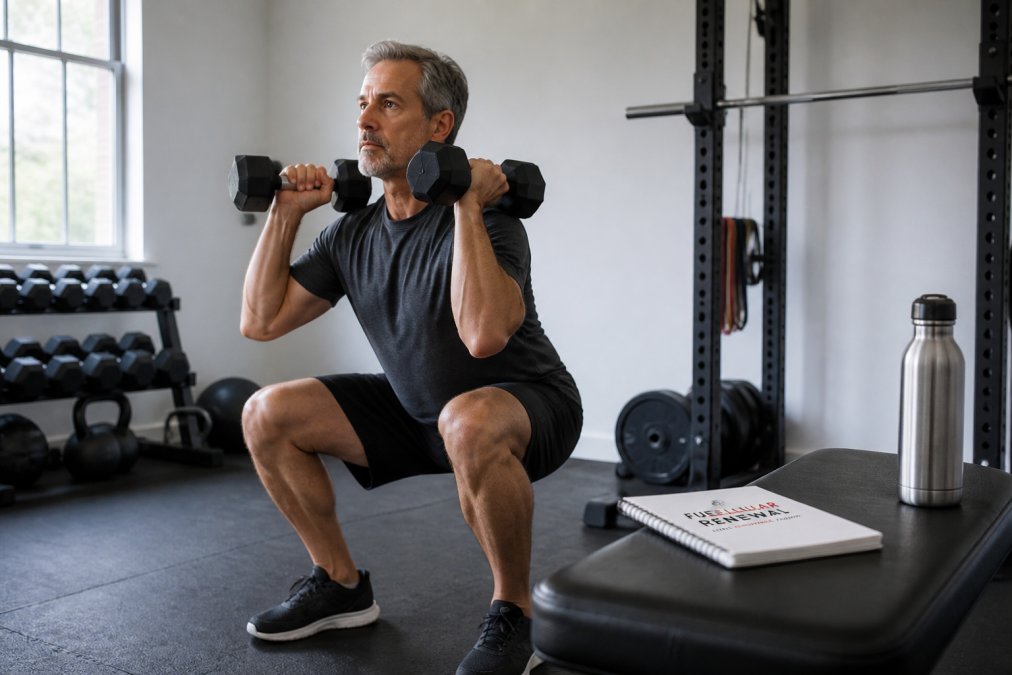
A fit adult in their 50s performing a controlled dumbbell squat in a bright home gym, with a notebook and water bottle nearby on a bench
Two to three sessions per week covering the major movement patterns is one reasonable, evidence-based example, not a universal prescription. Exercises such as squats, rows, and presses can efficiently train multiple muscle groups in a single movement. Progressive overload, gradually increasing weight or reps, is a common training principle used to progressively challenge muscles over time.
Protein intake matters alongside training. Adults generally benefit from spreading protein across meals rather than concentrating it at dinner, and total daily intake matters more than precise timing. For a deeper look at how strength and nutrition interact, ACSM position stands on resistance training provide evidence-based guidance.
Nutrition Strategies to Support Longevity Pathways
Dietary patterns linked to general metabolic and long-term health tend to emphasize nutrient density, fiber, and plant compounds rather than any single superfood. The pattern matters more than the individual ingredient.
A practical framework:
- Build meals around vegetables, legumes, and whole grains
- Include adequate protein at each meal
- Choose fats from olive oil, nuts, and fatty fish
- Limit refined sugar and ultra-processed foods
- Keep alcohol low or skip it
Calorie restriction and time-restricted eating are optional patterns some people try alongside this framework, but human evidence on their benefits is mixed and context-dependent, and neither is needed to influence these pathways. A nutrient-dense diet eaten in a normal window still supports metabolic health.
Polyphenols, Phytonutrients, and Bioactive Compounds
Polyphenols and other bioactive compounds are plant chemicals studied for their effects on oxidative stress and inflammation. Berries, dark leafy greens, coffee, tea, olive oil, and cocoa are common sources.
The evidence here is mostly observational and mechanistic. Populations eating more polyphenol-rich foods tend to have better health markers, but isolating any single compound has produced mixed results in trials. Whole foods are generally a practical way to get these compounds, while isolated supplements can have different evidence, doses, and effects.
Tracking Progress and Safety Considerations
Two things most articles on longevity pathways skip: how to tell whether anything is actually changing, and who should not attempt these practices. Both matter more than any single protocol.
What to Track (and What Not To)
You cannot directly measure AMPK, sirtuin, or autophagy activity at home, and the markers below don't tell you whether any of those pathways activated. What you can track are general indicators of fitness, metabolic health, body composition, and function that tend to move when the underlying habits are working. Treat them as trends, not verdicts, and interpret them alongside how you feel and perform.
Practical, low-cost markers:
- Resting heart rate. A stable or gradually lower resting heart rate over months is a reasonable general fitness signal. Wearable readings are estimates, not clinical measurements.
- Grip strength. A simple dynamometer or consistent hang test gives a rough strength trend; grip strength is used in aging research as a general marker of physical function.
- Waist circumference. Measured at the same spot, same time of day, roughly monthly. More informative than scale weight alone for many people.
- Sleep consistency. Not just duration, how consistent your sleep and wake times are. Wearable sleep-stage estimates are approximations; use them for patterns, not precision.
- Functional benchmarks. Stairs without stopping, a timed walk, a set number of push-ups or squats. These are often more motivating than lab values.
Lab markers worth discussing with a clinician. A standard metabolic panel, lipid panel, fasting glucose, HbA1c, and (if relevant) inflammatory markers like hs-CRP can be ordered through a primary care visit. These are general health markers, not "longevity pathway" tests. Interpret any result with a clinician rather than acting on a single number.
What not to chase. Heart rate variability and readiness scores from wearables are monitoring tools, not diagnostic devices. A single bad HRV day means little; a two-week downward trend alongside poor sleep and heavy training load is worth attention. Do not let a wearable score override how you actually feel.
Who Should Not Do This (or Should Modify It)
Fasting. A strict fast means zero caloric intake; fasting practices and research protocols vary widely. Skip or modify fasting if you are pregnant or breastfeeding, have a history of an eating disorder, have type 1 diabetes or insulin-managed type 2 diabetes, take medications that require food, or have a diagnosed condition where your clinician has advised against it. If you take prescription medications, ask your clinician whether timing matters, some drugs are dosed with food for a reason.
Heat and cold exposure. Skip or modify if you are pregnant, have cardiovascular disease, uncontrolled blood pressure, a history of cold agglutinin disease or Raynaud's phenomenon, or take medications that affect thermoregulation or blood pressure. Cold water immersion carries a small but real risk of cold shock and cardiac events, especially in unacclimated adults. Never do cold immersion alone.
Calorie restriction. Aggressive, prolonged restriction carries risks that outweigh the theoretical benefit for most people. If you have a history of disordered eating, are underweight, or are recovering from illness, this is not the tool for you.
Supplements. If you take prescription medications, have kidney or liver disease, are pregnant or breastfeeding, or have any diagnosed condition, talk with a clinician before adding supplements. Potassium intake in particular needs individualized guidance for anyone with impaired kidney function. If you take diuretics, ask your clinician how your specific medication affects electrolyte balance, loop and thiazide diuretics and potassium-sparing diuretics affect potassium differently.
A Simple Way to Sequence It
Start with well-supported general health habits that carry the least risk: consistent sleep and wake times, morning light, resistance training two to three times per week, and a mostly plant-based plate. A sustainable eating window is optional, not required. Tracking two or three markers for a few months is one practical example, not something science requires, before adding anything else. Heat, cold, or supplements aren't something you need to add next. If you do try them, a steady baseline in the basics first makes it easier to judge whether they're doing anything.
For those interested in NMN or NAD+ supplementation, Autophagy Nutrition offers options like Premium NMN and NAD+ capsules. These are convenience products, not substitutes for the habits above, and human outcome research on NMN and NAD+ is still developing.


Conclusion: Building Your Longevity Routine
The hardest part of this topic is accepting that no single input does the work alone. AMPK, autophagy, and related pathways can respond acutely to individual inputs, but meaningful long-term health outcomes depend on broader patterns of behavior built over months and years and cannot be inferred from pathway activation alone.
Start with well-supported general health habits: resistance training twice a week, a mostly plant-based plate, and a consistent sleep schedule. A restricted eating window is one optional pattern that works for some people, not a requirement. Heat, cold exposure, and targeted supplements are separate choices with their own evidence and tradeoffs, not a required next step after the basics. Explore Autophagy Nutrition products and choose options that fit your routine. Shop All and build the routine that lasts.
Frequently Asked Questions
What are longevity pathways in the human body?
Longevity pathways are cellular signaling systems that help regulate how your body responds to stress, nutrients, and energy demands. Key examples include AMPK, sirtuins, and mTOR, signaling systems involved in cellular energy sensing, nutrient signaling, growth, and stress-response processes studied in aging biology. Research in animal and cell models has identified how these pathways work, but human outcome research is still developing. Lifestyle habits such as exercise, fasting, and nutrient-dense eating can influence some of these pathways, though individual results vary.
Can lifestyle habits really influence cellular health and aging?
Yes, lifestyle habits can influence cellular processes associated with healthy aging. Regular physical activity, adequate sleep, stress management, and nutritious eating are linked in observational research to better metabolic health and lower inflammation. A diet rich in polyphenols and phytonutrients is an active area of research, but polyphenols themselves have not been demonstrated to lower inflammation or slow aging in humans. These associations do not prove that any single habit directly extends lifespan or reverses aging. The strongest evidence supports consistent, combined habits over time rather than one isolated intervention. Talk with a healthcare professional before making major changes if you have existing conditions.
Is there evidence that specific foods activate longevity genes?
Some laboratory and animal studies suggest that certain compounds in foods, such as polyphenols found in berries, green tea, and turmeric, may influence molecular pathways like AMPK and sirtuins. However, human evidence is limited and mostly observational. No single food has been proven to activate longevity genes in humans in a way that guarantees health outcomes. A plant-rich, nutrient-dense diet is a reasonable approach, but it should complement, not replace, other healthy habits.
How does nutrition support long-term wellness and healthy aging?
Nutrition supports long-term wellness by providing the macronutrients, micronutrients, and bioactive compounds your body needs for normal function. Diets emphasizing vegetables, fruits, legumes, whole grains, and adequate protein are consistently linked to better metabolic health and lower chronic disease risk in large population studies. Nutrient density matters more than any single superfood. If you are considering supplements like NMN or NAD+ precursors, note that human outcome research is still developing and these are not proven to extend lifespan or reverse aging.