
Does Creatine Break a Fast? What You Need to Know
Table of Contents
- What Is Creatine Monohydrate and How Does It Work?
- Does Creatine Break a Fast? The Direct Answer
- Creatine and Insulin Response: What the Research Shows
- Creatine, Autophagy, and Your Fasting Protocol
- Supplements That Break a Fast: How Creatine Compares
- Best Time to Take Creatine Around Your Fasting Window
- Conclusion
Last Updated: August 28, 2026
What Is Creatine Monohydrate and How Does It Work?
Creatine monohydrate is a naturally occurring compound synthesized primarily in the liver and kidneys, then transported to skeletal muscle where it supports cellular energy production. At the muscle level, creatine plays a well-established role in regenerating adenosine triphosphate (ATP), the primary fuel source for short-duration, high-intensity effort.

The body produces creatine in limited quantities. According to National Institutes of Health Office of Dietary Supplements creatine fact sheet, dietary sources like red meat and fish contribute to creatine stores, but the amounts shown in clinical research to support exercise performance and muscle protein synthesis are significantly larger than what endogenous production alone can provide. That gap is why supplementation became popular among athletes and active adults.
Creatine monohydrate is the most studied form. Micronized versions offer finer particle size, which can improve mixability. The core mechanism remains the same: creatine phosphate donates a phosphate group to ADP, rapidly regenerating ATP during high-intensity effort and supporting faster recovery between sets or intervals.
A standard 5-gram dose of pure, unflavored creatine monohydrate is essentially calorie-free, containing no fat, protein, or carbohydrate in meaningful amounts. At Autophagy Nutrition, we built our creatine formulation around this principle: supplement purity matters, especially for people who take their fasting protocols seriously.
Does Creatine Break a Fast? The Direct Answer
Pure unflavored creatine monohydrate contains no calories, produces no significant thermogenic effect, and does not trigger a substantial insulin response on its own.
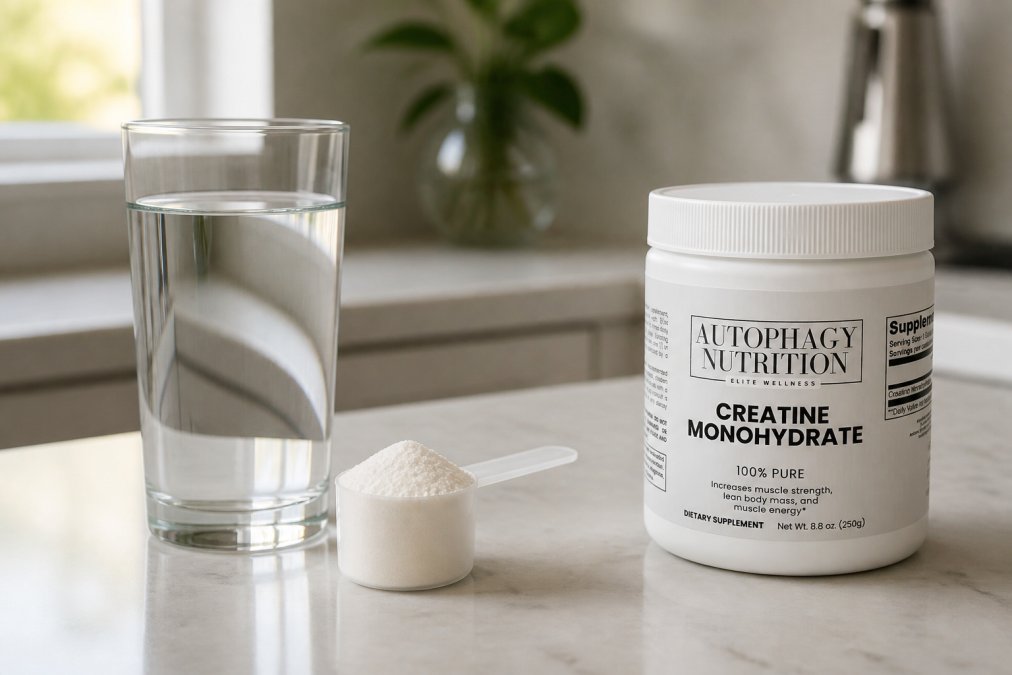
However, the answer depends on what you mean by "breaking a fast." Fasting means consuming zero calories. The question is whether a calorie-free substance entering the body during a fasting window could affect other fasting goals, such as cellular renewal processes.
Pure creatine monohydrate is calorie-free and insulin-neutral in its pure form, but it is still a substance entering the body during a fasting window. Whether that matters depends on your specific fasting goal.
Caloric Content and Fasting Thresholds
A standard 5-gram serving of pure creatine monohydrate powder contains zero calories. Since fasting requires zero caloric intake, pure creatine meets that standard and does not break a fast.
The important qualifier: this only applies to pure, unflavored creatine monohydrate. The moment you add flavoring agents, dextrose, or other carbohydrate-based carriers, the caloric picture changes.
Flavored vs. Unflavored Creatine During a Fast
Many flavored creatine products include added sugars, dextrose, or maltodextrin to improve taste or enhance absorption. Dextrose is a fast-digesting sugar that will raise blood glucose and trigger an insulin response. Artificial sweeteners like sucralose are calorie-free, but some research suggests they may influence gut microbiome activity and insulin sensitivity, though evidence in humans remains mixed.
If you are fasting, unflavored creatine monohydrate in pure powder form eliminates these variables. Read the label carefully: if your creatine product contains anything beyond creatine monohydrate and perhaps a minimal anti-caking agent, evaluate each ingredient individually.
Creatine and Insulin Response: What the Research Shows
Pure creatine monohydrate on its own does not appear to cause a significant spike in blood glucose or insulin. It contains no carbohydrates and no amino acids in meaningful amounts that would drive a strong insulin secretion response.
Research has shown that creatine uptake into muscle tissue is enhanced in the presence of insulin. This is why some loading protocols combined creatine with simple sugars or dextrose. For someone fasting, taking pure creatine means it will be absorbed, but potentially at a slower rate than if taken with carbohydrates. For most people supplementing creatine for long-term muscle saturation, this slower absorption rate is not a meaningful problem.
According to International Society of Sports Nutrition position stand on creatine, creatine monohydrate is the most effective ergogenic nutritional supplement currently available for increasing high-intensity exercise capacity and lean body mass during training. The position stand notes that timing and co-ingestion factors influence uptake rate but not long-term muscle saturation when supplemented consistently.
Creatine, Autophagy, and Your Fasting Protocol
Autophagy is a cellular process in which the body identifies and breaks down damaged or dysfunctional cellular components, recycling them for energy or repair. At Autophagy Nutrition, our framework centers on supporting the conditions that promote cellular renewal as part of a broader wellness strategy.
Most research on fasting-induced autophagy comes from animal and cell studies. Human data on the precise conditions that activate or inhibit autophagy, and the degree to which specific supplements affect it, remains an active area of research rather than settled science. Creatine itself is not a protein or amino acid, so its direct interaction with autophagy-regulating pathways like mTOR differs from consuming a protein supplement. However, the distinction between "no calories" and "no cellular signaling" requires careful handling.
The conservative approach for anyone fasting with cellular renewal as a primary goal is to take creatine outside the fasting window, during your eating period, where the question of interference becomes irrelevant. This is not a statement that creatine definitively disrupts autophagy-related processes. It is an acknowledgment that the evidence does not yet support definitive claims in either direction for human outcomes.
Supplements That Break a Fast: How Creatine Compares
Not all supplements behave the same way during a fasting window. Understanding where creatine sits relative to other common supplements clarifies the nuance in the question.
Supplement |
Calories |
Insulin Response |
Adds Meaningful Calories? |
Notes |
|---|---|---|---|---|
Pure creatine monohydrate |
Negligible |
Minimal |
No |
Calorie-free; insulin-neutral |
Flavored creatine with dextrose |
Moderate |
Significant |
Yes |
Added sugars drive insulin spike |
Whey protein |
Significant |
High |
Yes |
Amino acids trigger insulin |
BCAAs |
Low-moderate |
Moderate |
Yes |
Amino acids may affect mTOR |
Caffeine (black coffee) |
Negligible |
Minimal |
No |
Widely considered fasting-compatible |
Electrolyte powder (no sugar) |
Negligible |
Minimal |
No |
Depends on formulation |
Collagen peptides |
Moderate |
Low-moderate |
Yes |
Contains calories and amino acids |
Multivitamins |
Negligible |
Minimal |
Generally no |
Check for added sugars or oils |
The pattern is clear: supplements that break a fast contain calories, carbohydrates, amino acids, or added sugars. Pure creatine monohydrate does not fall into any of those categories. Flavored creatine products, however, often do. Supplement purity and label transparency matter significantly for anyone committed to a structured fasting protocol.
Best Time to Take Creatine Around Your Fasting Window
For most people practicing intermittent fasting, the eating window itself is the optimal time to take creatine.

Taking creatine with or immediately after a meal eliminates any question about your fasting state and supports faster muscle uptake because of the natural insulin response to eating. For people who train during a fasting window, taking pure creatine before or during a fasted workout may not noticeably affect energy levels given the negligible caloric content, though this depends on your specific fasting goals.
Sports nutrition research supports consistent daily dosing over precise timing. Creatine's benefits come from muscle saturation over time, not from any single dose taken at a specific moment.
Bioavailability, Stomach Sensitivity, and Hydration
Creatine can cause gastric distress when taken on an empty stomach, particularly during a fasting window. Common symptoms include bloating, cramping, and nausea. Micronized creatine monohydrate has a finer particle size, which can improve mixability. Taking creatine with a large glass of water also helps.
Hydration is critical in creatine supplementation. Creatine draws water into muscle cells as part of its mechanism, which means adequate hydration is essential. During a fasting window, when food-based water intake is absent, deliberate fluid intake becomes more important. For those with sensitive digestion, the simplest solution is to take creatine with your first meal of the eating window.
Long-Term Metabolic Adaptation and Daily Dosage
Creatine supplementation, practiced consistently over weeks and months, produces gradual changes in how muscle tissue handles energy. Phosphocreatine stores increase, ATP regeneration becomes more efficient, and recovery between high-intensity efforts improves.
For people practicing intermittent fasting as a long-term lifestyle strategy, this matters. The metabolic benefits of creatine accumulate over time, which means daily dosage and consistency are far more important than precise timing within any given day.
According to Mayo Clinic overview of creatine supplementation, a standard maintenance dose of 3 to 5 grams per day is sufficient for most adults once muscle stores are saturated. A daily 5-gram dose of pure creatine monohydrate, taken at whatever point fits your eating window and schedule, will produce the same long-term muscle saturation and performance support as a precisely timed dose.
For active adults over 40, where preserving muscle mass and supporting recovery become increasingly important priorities, the consistency of creatine supplementation is the variable that drives outcomes. Autophagy Nutrition's Premium Creatine Monohydrate Powder is formulated as a pure, unflavored powder specifically to give users full control over when and how they incorporate creatine into their routine.
Research from Harvard T.H. Chan School of Public Health nutrition source on creatine supports the established role of creatine in muscle energy metabolism, noting that it is one of the most well-researched sports supplements available.
The question of whether creatine affects your fasting state is one of the most common concerns among people who take both their fasting protocols and their performance seriously. Pure unflavored creatine monohydrate is calorie-free and does not trigger a substantial insulin response on its own. The complications arise with flavored products, added sugars, and fasting goals centered on cellular health processes, where the evidence is still developing and the conservative approach is to supplement during your eating window.
Autophagy Nutrition's Premium Creatine Monohydrate Powder is designed for exactly this kind of intentional supplementation: pure powder, no additives, no hidden ingredients, and full label transparency so you can make an informed decision about timing. For active adults committed to both fasting and performance, clean supplementation is not a compromise. Shop All at autophagynutrition.com and take control of what goes into your protocol.
Frequently Asked Questions
Does creatine break ketosis?
Pure creatine monohydrate contains no carbohydrates, so it does not directly supply glucose or raise blood sugar in the way that carbohydrate intake does. However, some flavored creatine products include dextrose or other carbohydrate additives that can affect blood glucose and potentially disrupt ketosis. If maintaining ketosis is your goal, check the label carefully and opt for an unflavored, pure powder with no added sugars or fillers.
Does creatine interfere with autophagy?
Most autophagy research in humans focuses on caloric intake and insulin signaling as the primary regulators of this cellular process. Pure creatine monohydrate provides no calories and appears to have a minimal direct insulin effect on its own. That said, current evidence does not confirm that any supplement is fully neutral with respect to autophagy signaling. Anyone prioritizing autophagy as part of a fasting protocol should discuss supplement timing with a qualified healthcare provider.
How does creatine affect insulin levels during a fast?
Research suggests that pure creatine monohydrate, taken alone without carbohydrates, produces little to no measurable insulin response. This distinguishes it from many other supplements and sports nutrition products. However, creatine is often combined with dextrose or sugary mixers to enhance uptake, and those additions do trigger an insulin response. During a fasting window, the form and formulation of creatine matter significantly for preserving the metabolic state you are working to maintain.
Should I take creatine during my eating window or fasting window?
Taking creatine during your eating window is the approach most consistent with preserving fasting goals, as food co-ingestion supports absorption and reduces the risk of gastric distress on an empty stomach. Creatine taken with a meal or post-workout shake also benefits from the natural insulin response that food produces, which can support muscle uptake. Timing it at the start of your eating window, particularly after training, aligns supplementation with your body's nutritional needs.
This article was written using GrandRanker